Why the Donate Bag Sits by the Door for Three Weeks
Quick Answer: The donate bag stalls because decluttering and disposing are two different tasks with different requirements, and only the first one is emotionally satisfying. Sorting happens at home, alone, whenever you feel like it. Dropping off requires transport, opening hours, and a trip that produces no visible reward. The fix is to schedule the drop-off before you start sorting, and to sort only as much as fits in one trip.
The bag by the door is not a failure of discipline. It is a task that was never actually planned.

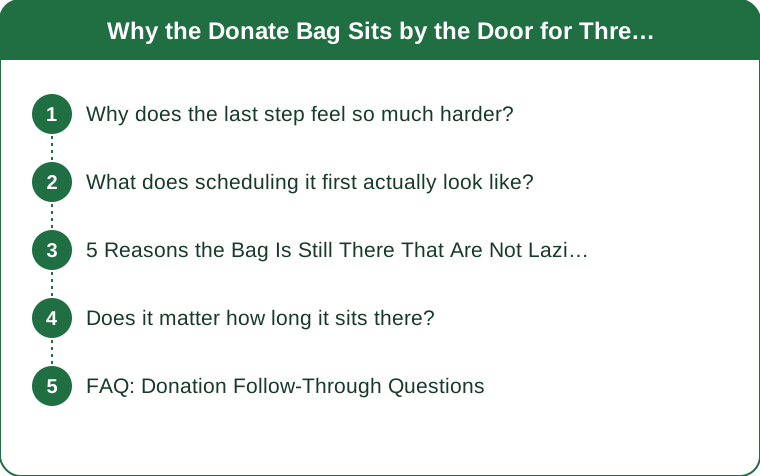
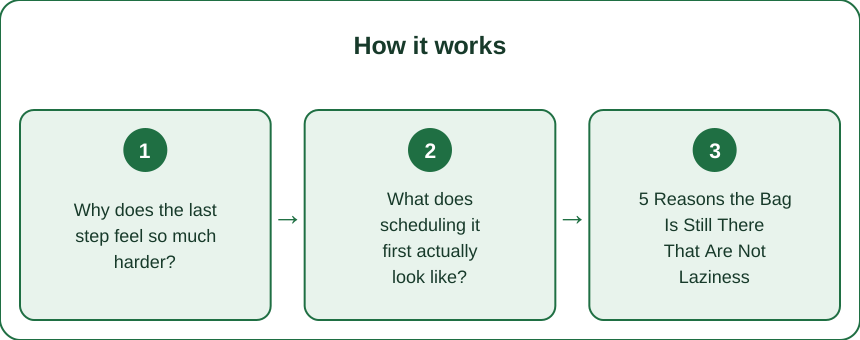
Why does the last step feel so much harder?
Because it has none of the properties that made the first step happen.
Sorting is immediately rewarding. You can see the shelf empty out. The room looks better within minutes. There is a clear feedback loop between effort and visible result, which is exactly the structure that makes a task feel good to do.
Dropping off has the opposite structure. The visible result already happened - the room is already tidy. The trip produces no further improvement to your environment, only the removal of a bag you have already stopped seeing.
Worse, the trip has real friction: it requires a vehicle or a walk with an awkward load, it must happen during the donation center’s opening hours, and it usually needs to be combined with another errand to feel worth doing.
So you have a task with high friction, no visible reward, and a time constraint, competing against everything else in your week. It loses, every week, and each week it becomes slightly more invisible as you habituate to the bag being there.
That habituation is the real problem. After about ten days most people stop seeing the bag at all.
What does scheduling it first actually look like?
Working backward from the drop-off rather than forward from the sorting.
Pick the drop-off slot before you sort anything. Check the hours of your nearest donation point, pick a specific day and time in the next seven days, and put it in your calendar as an appointment rather than a to-do. A task on a list is optional; an appointment has a time.
Sort only what fits in one trip. This is the constraint that makes the whole thing work. If your car holds three bags, sort three bags’ worth. The instinct to declutter the whole house in one weekend produces eleven bags and no plan for any of them.
Attach it to a trip you are already making. The single highest-success pattern is combining the drop-off with an existing routine - the weekly grocery run, the school pickup, the gym trip. A dedicated trip for donations is a trip most people never take.
Put the bags in the car immediately, not by the door. This is the smallest change with the largest effect. A bag in the boot goes with you every time you drive and will eventually be dropped off almost by accident. A bag by the door requires a decision to load it.
That last one alone resolves the problem for a lot of people.

5 Reasons the Bag Is Still There That Are Not Laziness
-
You have not decided where it goes. Charity shop, textile recycling, a specific friend, a buy-nothing group - each has different rules and hours. An undecided destination means the trip cannot be scheduled, and the bag waits on a decision rather than on effort.
-
Some items in it are not actually donatable. Worn-out clothing, single shoes, stained items. A bag containing a few things you know will be rejected creates a low-grade dread about handing it over. Split it: donation bag and textile-recycling bag.
-
You are not fully done deciding. If any item in the bag is still under negotiation, part of you is keeping the bag accessible on purpose. That is worth acknowledging - take the uncertain items out and put them somewhere with a one-month deadline rather than holding the whole bag hostage.
-
It is too heavy or too many bags. A load you cannot carry in one trip from door to car is a load you will postpone. Repack into smaller bags.
-
You are waiting for the right charity. Wanting the items to go somewhere they will be genuinely useful is a good instinct that frequently becomes a stalling mechanism. If it has been more than two weeks, the nearest option that accepts them is the right one.
The third one is the most common and the least often admitted.
Does it matter how long it sits there?
More than you would think, for three reasons.
Habituation. Within about ten days the bag becomes part of the visual furniture and stops prompting you. After that, only a deliberate reminder gets it moved.
Re-entry. The longer it sits, the more likely items get pulled back out. This is not always bad - occasionally you genuinely needed something - but mostly it is decision reversal driven by seeing the item again rather than by needing it. Opaque bags close this loop. A clear bag keeps the contents in play; a closed opaque one does not.
Seasonal windows close. Summer clothing donated in late August is useful to someone immediately. The same items donated in November go into storage or get processed as bulk textile. Right now, at the seasonal turn, is genuinely one of the better moments of the year to move summer items along - which is also why donation points get busy in the next few weeks and going earlier in the day is worth it.
A reasonable rule: if the bag has been there for more than seven days, put it in the car today even if you have no plan for when you will drop it off. Moving it from the hallway to the boot changes the odds substantially.
FAQ: Donation Follow-Through Questions
What do I do with things nobody will take?
Worn-out textiles can usually go to textile recycling, which many donation points and some retailers accept separately. Knowing this in advance prevents the mixed-bag dread that stalls the whole trip.
Is it worth trying to sell instead?
Sometimes, but be honest about the time cost. Selling requires photographing, listing, responding, and posting - typically 20 to 40 minutes per item for a modest return. It is worth it for genuinely valuable items and it is the most common reason a declutter never completes. Set a firm deadline: unsold after three weeks means donated.
How do I stop the next bag from stalling too?
Keep a permanent donation bag in one spot and take it when it is full, rather than running periodic purges. A standing container with a standing destination removes the planning step entirely, which was the actual obstacle all along.
TL;DR:
- Sorting is immediately rewarding; dropping off has friction, a time constraint, and no visible reward - so it loses every week.
- Schedule the drop-off before you start sorting, and sort only as much as fits in one trip.
- Put the bags in the car rather than by the door - this one change resolves it for many people.
- Split out non-donatable items and pull out anything you are still deciding on, so the bag is not held hostage.
- After about ten days you stop seeing the bag entirely, so seven days is a good hard deadline.
Late summer is a genuinely good window to move summer clothing along while it is still immediately useful to someone.
Keep Reading
This article is for general informational and styling purposes only. Fit, sizing, and product availability may vary.