How to Declutter When Everything You Own Is Technically Useful
Quick Answer: When everything is useful, usefulness has stopped being a decision criterion and you need a different one. Three work: replacement cost (would I buy this again today at full price?), duplication (how many of this category do I own, and how many can I use at once?), and the storage tax (is this item worth the space, the searching, and the maintenance it costs?). Categories beat rooms, because duplication is only visible when all of a thing is in one pile.
Most decluttering advice starts from the same assumption: your home contains obvious junk, and you are being sentimental or lazy about removing it.
For plenty of people that is just wrong. There is no junk. There is a perfectly good second kettle, three usable tote bags, a functioning older laptop, camping gear used twice a year, and a drawer of cables that all connect to something you own.
Every single item passes the useful test. The house is still too full. And the standard advice has nothing to say, because it has already assumed away your actual problem.

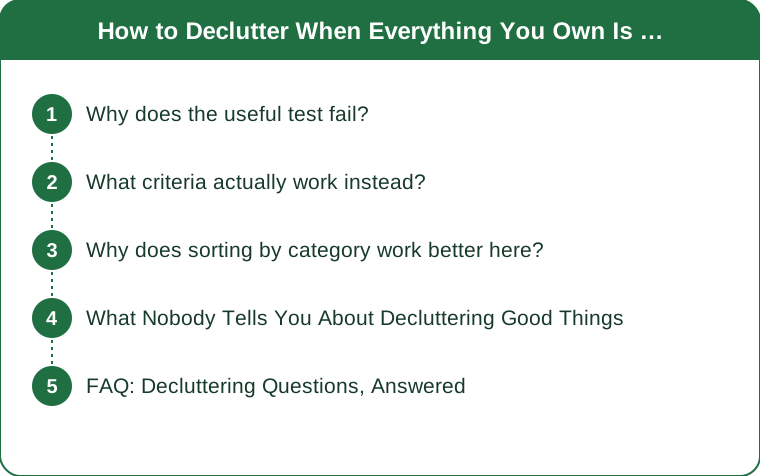
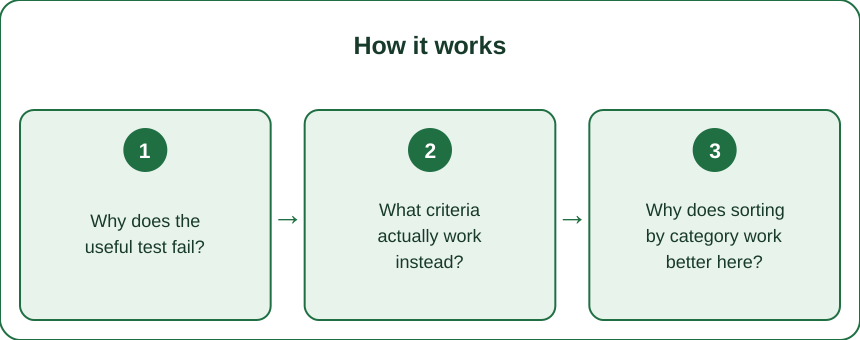
Why does the useful test fail?
Because useful is a property of the object and your problem is a property of the collection.
A thing is useful if there is a plausible situation in which you would want it. That bar is extremely low and almost everything clears it, which means the test cannot discriminate. Run it across a full house and it returns yes for nearly every item, and yes for everything is the same as no information.
Worse, the test is asymmetric in a way that quietly favours keeping. Imagining a use is easy and concrete - I could use this for camping - while imagining the cost is abstract and diffuse. You compare a vivid benefit against an invisible cost, and the benefit wins every time.
There is a genuine loss aversion effect here too: parting with something you own registers as a larger loss than acquiring the same thing registers as a gain. This is why the ‘would I buy it again’ question is so effective - it flips the frame from losing something you have to acquiring something you do not, and the answer often changes completely.
And there is a specific trap for people who are careful with money or conscious about waste. Getting rid of a functional item feels wasteful, so the item stays - and eight years later it leaves anyway, having spent all that time occupying space. The waste occurred at purchase. Keeping it does not undo it; it just adds storage cost on top.
What criteria actually work instead?
Three, in order of how much they cut.
1. Replacement cost. ‘Would I buy this today, at full price, knowing what I know?’
This is the strongest single question available, and it works because it removes the sunk cost entirely. You are not deciding whether to lose something. You are deciding whether to acquire it. A surprising proportion of a full house fails this instantly - not because the items are bad, but because you would not choose them again.
The useful refinement: if the answer is ‘not at full price, but yes if it were cheap’, that is a no. You already own it at the cost of the space it takes.
2. Duplication. ‘How many of this do I have, and how many can I use simultaneously?’
This is where the volume actually is. Every individual tote bag is useful. Eleven tote bags is a storage problem, and no single-item test will ever catch it because each one passes on its own merits.
Set a working number per category, and let the number do the deciding rather than your judgement in the moment. Three tote bags. Two sets of bedding per bed. One backup charger per device type. The number is arbitrary and that is fine - its job is to convert an emotional decision into an arithmetic one.
3. The storage tax. ‘Is this worth what it costs to keep?’
Every item costs space, findability, maintenance, and a small amount of attention. A rarely-used item that lives behind three other things has a high tax and a low return - and it makes the things in front of it harder to reach, so the cost is not even contained to itself.
The question that makes this concrete: ‘If I needed this tomorrow, could I find it in under two minutes?’ If not, you do not functionally own it. You are storing it.

Why does sorting by category work better here?
Because duplication is invisible room by room and it is where most of your excess lives.
Go cupboard by cupboard and you never see that you own eleven tote bags, because they are in four rooms and each group of three looks entirely reasonable. Pile all of them on the bed and the decision makes itself without any agonising - which is the whole point.
The categories that most reliably hide duplication:
- Bags of all kinds - totes, gym bags, backpacks, the ones that came free with something
- Cables, chargers and adapters - the classic drawer, where every cable connects to something and half of those things are gone
- Water bottles and travel mugs - accumulate through gifts and events, never audited
- Bedding and towels - the ‘spare set’ that has become four spare sets
- Activewear - genuinely useful, and the drawer holds three times what a week’s training needs
- Kitchen tools with one function - each defensible, collectively a full drawer
Work in one-category sessions of about twenty minutes. Gather all of a thing, count it, set your number, keep the best ones, and move the rest out that day.
And ‘out that day’ is doing important work in that sentence. The single biggest failure point in this whole process is the bag by the door that stays there for six weeks and then gets absorbed back into the house. Decisions decay. A decluttering session that ends with a bag still in the hallway has not finished.
What Nobody Tells You About Decluttering Good Things
The hard part is not the decision, it is the disposal. With genuine junk you throw it away and it is done. With perfectly good items there is a moral weight to disposing of them properly - the right charity, the resale listing, the friend who might want it - and that admin is what stalls the whole project. Decide in advance where things go, and accept that donating something worth £40 rather than selling it is a fair price for the project actually completing.
Keeping the best version of a category is more effective than keeping a percentage of everything. One excellent tote bag you enjoy using beats four adequate ones. Most people distribute their cuts evenly across categories and end up with a slightly thinner version of the same problem.
Storage solutions are usually a way of avoiding the decision. A new set of boxes converts a visible problem into an invisible one at the cost of money and space. If you are shopping for storage before you have counted the category, you are postponing.
The category you resist most is usually the one with the most excess in it. Reliably. Notice the flinch, and start there anyway - it will produce more result per session than anything else.
And late August is genuinely the best window of the year for this. The summer-to-autumn wardrobe swap is already forcing you to handle everything, the school-year reset is about to bring new things into the house, and clearing space before the influx is much easier than clearing it after.
FAQ: Decluttering Questions, Answered
What if I get rid of something and then need it?
It happens, and it is worth knowing how rarely: most people who track this find it is a small handful of items out of hundreds, and the replacement cost of those few is far lower than the storage cost of everything they kept just in case. Ask specifically how much it would cost and how long it would take to replace. If the answer is twenty pounds and two days, that is a cheap insurance policy to decline.
How do I handle items that were expensive but I never use?
Separate the two questions, because they get tangled. What you paid is gone regardless of what you do next - keeping the item does not recover any of it. The only live question is whether the item earns its space from today onward. If it genuinely might be worth selling, give it a deadline: listed within two weeks or donated, no third option.
Should I declutter room by room or all at once?
By category, not by room, and one category per session. Rooms hide duplication, which is where most of the excess lives. Twenty-minute single-category sessions also avoid the decision fatigue that makes hour three of a big purge so much worse than hour one - and the decisions you make when tired are the ones you regret.
General organising guidance. If clutter is causing significant distress or your home is becoming unsafe to move through, that is worth talking to a professional about.
TL;DR:
- Useful is not a criterion when everything passes it. You need a different question.
- Would I buy this again today at full price? The strongest single test, because it removes sunk cost.
- Count the category. Duplication is where the volume is, and it is invisible room by room.
- The storage tax: if you could not find it in two minutes, you are storing it rather than owning it.
- Get it out of the house the same day. The bag in the hallway is where decluttering projects go to die.
A house full of good things that is still too full is not a discipline problem. It is a problem with the question you have been asking, and a better question does most of the work.
Keep Reading
This article is for general informational and styling purposes only. Fit, sizing, and product availability may vary.