Why You Keep Re-Cluttering the Same Surface
Quick Answer: Recurring clutter surfaces are not failures of tidiness — they are places where an object’s real home is further away than the surface is. Clutter accumulates wherever the friction of putting something away exceeds about ten seconds. Fix the storage location, not the habit, and the surface stays clear.
Every home has three or four of these, and they are almost always the same three or four across completely different households.

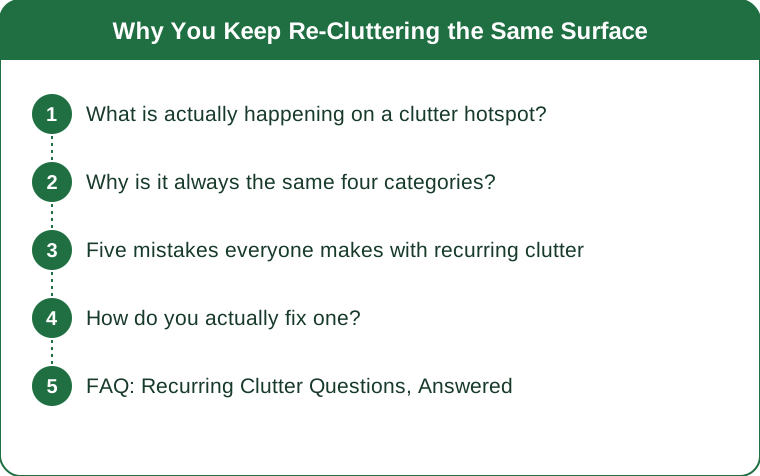
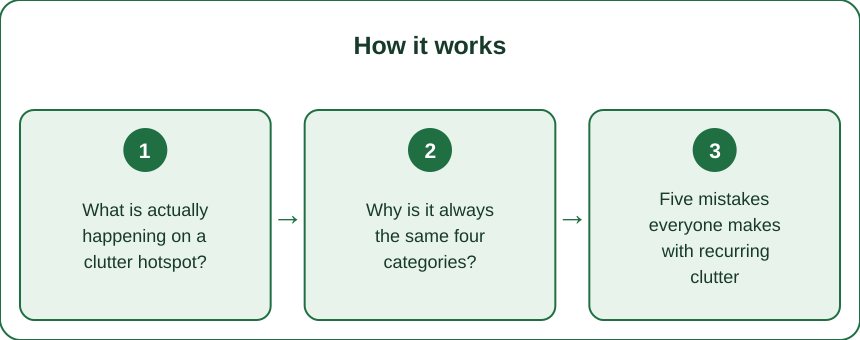
What is actually happening on a clutter hotspot?
A hotspot is a decision deferral point. It forms where you enter a space carrying things and where the correct destination for those things is somewhere else.
Watch the entryway table. It collects keys, post, sunglasses, receipts, a parcel, a scarf. Every one of those items has a real home, and every one of those homes is at least one room away. You arrive holding six things, you have one free hand, and the table is right there.
The surface is not the problem. The surface is the symptom of six storage decisions that were made badly.
This is why decluttering the surface never works. You clear it on Sunday, and by Wednesday the same six categories have reassembled, because nothing about the underlying geometry changed. You removed the output and left the input running.
Why is it always the same four categories?
Because the same four categories share a property: they have no obvious single home.
Things in transit. Post to be dealt with, a parcel to return, a form to sign. These are genuinely homeless because they are temporary. They need a designated in-transit container, not a permanent home.
Things used in more than one room. Chargers, scissors, hand cream, reading glasses. Anything used in three rooms will be put down in whichever room it was last used in, forever. The answer is usually to own three cheap ones rather than to keep relocating one.
Things at an in-between cleanliness level. The chair pile is entirely this — worn once, not dirty enough to wash, too worn for the wardrobe. There is no designated storage for this state in most homes, so it goes on the chair.
Things with a pending decision. The item you might return, the gift you might regift, the cable you are not sure still works. Storing them is easy; deciding is what you are avoiding, and the surface is where avoided decisions live.

Five mistakes everyone makes with recurring clutter
1. Treating it as a discipline problem. It is a logistics problem. If putting something away takes four steps and two hands, it will not happen when you are tired, and you are tired most of the time you are carrying things.
2. Clearing without redesigning. Clearing a surface without changing where those items live guarantees it refills. Every clear-out that does not end with a new storage decision is temporary by construction.
3. Buying storage before observing. The basket arrives, gets filled with the same clutter, and now you have a full basket instead of a full surface. Watch what accumulates for one week and write down the categories before buying anything.
4. Making the new home aspirational rather than convenient. The correct place for the worn-once jumper is not the bottom of the wardrobe behind a door. It is a hook, in the open, in the room where you take it off.
5. Trying to fix all the hotspots at once. Pick the one that annoys you most, fix its logistics properly, and let it hold for three weeks before starting the next. Fixing four at once means fixing none of them well.
The third mistake surprises people who have already spent money on the problem.
How do you actually fix one?
A four-step process that takes a week and mostly consists of not doing anything.
Days 1-7: observe. Do not clear the surface. Every time you put something on it, write the category on a list stuck nearby. At the end of the week you have the real inventory rather than the one you imagined.
Day 8: sort the list into three groups. Things with a home that is too far away. Things with no home at all. Things that should not be in the house.
Day 9: fix the geometry. For the first group, move the home closer or duplicate the item. For the second, create a home within arm’s reach of the hotspot — a tray, a hook, a small drawer. The container goes where the clutter already goes, not where you wish it went.
Day 10 onwards: one weekly reset. Five minutes, same day each week. A well-designed hotspot needs a reset, just a short one. A badly designed one needs an hour and still refills.
Late summer note: the seasonal transition is the single best moment to do this. Late August is when the summer layer of stuff — sunscreen, sunglasses, hats, sandals — is still in circulation but about to stop being needed, and you can see clearly which surfaces were carrying it.
FAQ: Recurring Clutter Questions, Answered
Is it fine to just accept a designated messy surface?
Completely, and it is often the best answer. A tray on the entryway table that is allowed to be full is a designed solution, not a defeat. The problem is unbounded spread, not the existence of a landing zone.
Why do I only notice the clutter when someone is coming over?
Habituation. Your visual system stops registering a static scene after a few days. Photographing the room on your phone breaks it — a photo of your own living room shows you what a visitor sees, and the effect is immediate and slightly alarming.
What about clutter that is genuinely sentimental?
Different problem, different solution. Sentimental items do not belong in hotspot triage because the decision cost is high and the volume is low. Give them a real container and a real place, and deal with them as a separate project on a day you have chosen deliberately.
TL;DR:
- Hotspots form where an item’s real home is more than about ten seconds away — it is geometry, not discipline.
- The same four categories recur everywhere: things in transit, multi-room items, worn-once clothes, and deferred decisions.
- Observe for a week before buying any storage; the imagined inventory is never the real one.
- Put the new container where the clutter already lands, not where you wish it landed.
- Fix one hotspot at a time and give it three weeks before starting the next.
A cleared surface tells you nothing about whether the problem is solved. A surface that is still clear on the following Wednesday tells you everything.
Keep Reading
This article is for general informational and styling purposes only. Fit, sizing, and product availability may vary.