The Maybe Box That Never Gets Reopened
Quick Answer: The maybe box works only if it has a date on it and a rule attached. Without those, it converts a decluttering session into a deferral and moves the clutter rather than resolving it. Give the box a hard review date three to six months out, write the date on the outside, and commit in advance that anything you have not looked for by then leaves unopened. The point is not the box - it is that the box has to be able to make the decision for you when you cannot.
You made the box because you could not decide. Which means the box is full of exactly the items you will still not be able to decide about later.
That is the flaw, and it has a straightforward fix.

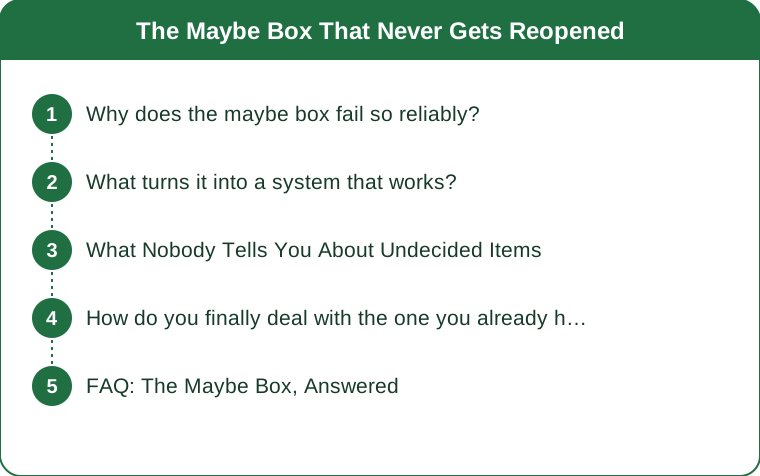
Why does the maybe box fail so reliably?
It is a deferral disguised as a decision. Putting something in the box feels like progress because it leaves the drawer, but nothing has actually been resolved - the decision has been moved into the future along with the object.
Nothing forces you to reopen it. A box with no date and no rule has no mechanism to ever be dealt with. Left to its own devices it becomes permanent storage, which is what you were trying to avoid.
The items in it are the hardest ones by definition. Everything easy went to keep or donate. The box contains only the genuinely ambiguous items, so opening it means facing a concentrated collection of difficult decisions all at once.
Sealing it removes the useful information. If you cannot see what is in the box, you cannot notice that you never needed any of it. The evidence you would use to decide is exactly what the box hides.
And it grows. Once a maybe box exists, subsequent decluttering sessions add to it, because there is now a socially acceptable place to put anything difficult.
None of this means the concept is wrong. A time-limited maybe box is genuinely useful for reducing the anxiety that stops people decluttering at all. An undated one is just a smaller, tidier version of the problem.
What turns it into a system that works?
Write the review date on the outside in large numbers. Three months for clothing and kitchen items, six for sentimental or seasonal ones. A date you can read from across the room is what stops it becoming invisible.
Write the rule on the box too. Something like: if I have not opened this by the date, it goes unopened. Deciding the rule in advance, when you are motivated, is far easier than deciding it later when you are not.
Do not seal it. Leave it accessible so you can retrieve anything you actually need. Retrieval is the test - an item you go and get is one you should keep, and the box gives you that data automatically.
Keep a list taped to the lid. A quick written inventory means you can check whether something is in there without opening it, and it makes the eventual decision far less overwhelming.
Store it somewhere slightly inconvenient but visible. Out of your daily flow so it is not in the way, but not in a loft or a back cupboard where it will disappear from your awareness entirely.
And set a calendar reminder for the date. A note on the box is easy to stop seeing. A reminder that arrives on your phone is not.

What Nobody Tells You About Undecided Items
The number of items you retrieve is almost always close to zero. People who track it typically find they go back for one or two things out of dozens. That figure is the most useful piece of evidence you can generate about your own attachment.
Guilt is usually about money, not the object. Most maybe-box items are things that cost money and were not used. Keeping them does not recover the money; it only adds storage cost to the original loss.
Sentimental items behave differently and deserve different rules. A separate, deliberately kept memory box with no review date is a legitimate choice. The mistake is mixing genuinely sentimental items with unresolved practical ones - the sentimental ones then protect the rest from ever being reviewed.
The box is often about identity rather than utility. The running gear from the version of you who was going to run, the dress for the size you were, the hobby kit for the hobby you meant to start. Those decisions are about a self-image, which is why they are hard and why the box does not help.
Opening it feels much worse in anticipation than in practice. Most people report that the actual review takes twenty minutes and is unexpectedly easy, because time has removed the emotional charge from most items.
And the box has a cost you are not counting. Storage space, the mental weight of an unresolved task, and the periodic reminder that you did not deal with it. That cost is ongoing and the item’s value is not.
How do you finally deal with the one you already have?
Do not open it. Check the list instead. If you kept an inventory, read it. If you can read the whole list without wanting anything specific, the box can leave as it is.
If there is no list, give yourself fifteen minutes and a timer. Speed prevents the item-by-item deliberation that makes this exhausting. Fast decisions on ambiguous items are, in practice, about as good as slow ones.
Sort into three piles only: use now, sell or donate, discard. Do not create a second maybe pile. If you genuinely cannot decide, it goes with the donations - that is what the original box already told you.
Notice the date on it. If it has been more than a year, you already have your answer: an entire cycle of seasons passed and you needed none of it.
Get the outgoing items out of the house the same day. A donation bag by the door has an extremely high chance of being reopened, which is how the whole process starts again.
And write down what you retrieved. Two items out of forty is a number that will make your next decluttering session dramatically faster, because you will trust yourself to let things go.
FAQ: The Maybe Box, Answered
How long should you keep a maybe box?
Three months for clothing and everyday items, up to six for seasonal or sentimental ones. Longer than that and the box has become storage rather than a decision tool.
Should I seal the maybe box?
No. Leaving it accessible lets you retrieve what you genuinely need, and what you retrieve is the most useful evidence you can get about which items actually matter.
What if I cannot decide when the date arrives?
That is what the pre-committed rule is for. Deciding in advance that unopened means gone means you do not have to make the hard decision twice.
Is a maybe box a bad idea in general?
Not at all - it reduces the anxiety that stops people decluttering. It fails only when it has no date, no rule, and no list, at which point it becomes clutter with better packaging.
TL;DR:
- An undated maybe box defers decisions rather than making them, and quietly becomes permanent storage.
- Write the review date and the rule on the outside, keep an inventory list on the lid, and set a calendar reminder.
- Do not seal it - retrieval is the evidence, and most people go back for one or two items out of dozens.
- Keep genuinely sentimental items in a separate memory box so they do not shield unresolved practical items from review.
- When the date arrives, use a fifteen-minute timer, allow only three piles, and get the outgoing bag out of the house the same day.
The box is not the problem. The box without a date on it is.
Keep Reading
This article is for general informational and styling purposes only. Fit, sizing, and product availability may vary.