Why the Back of Your Closet Collects the Same Four Categories
Quick Answer: The back of a closet is not random - it collects four predictable categories: aspirational sizing, event-only pieces, guilt purchases, and almost-right items. Each one is stuck there for a different reason, and each one needs a different decision rule. Sorting by category rather than by garment turns a two-hour agonizing session into a 20 to 30 minute pass, because you make four decisions instead of forty.
You already know what is back there. That is the strange part - almost everyone can list it without looking, and still nothing moves.

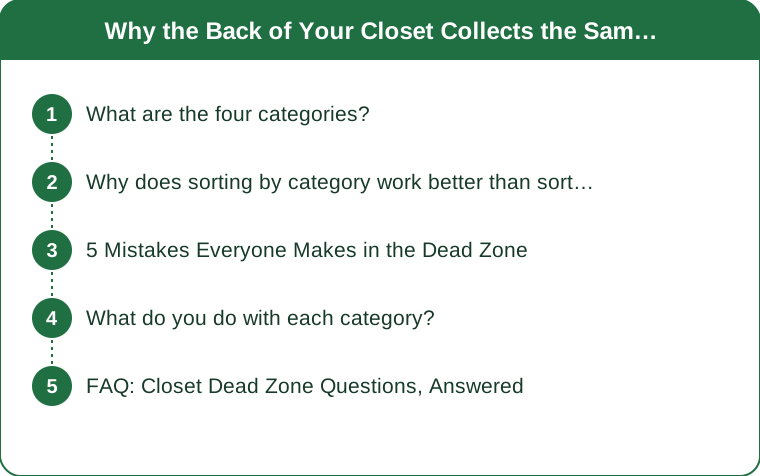
What are the four categories?
1. Aspirational sizing. Clothing kept for a body other than the current one, in either direction. It is the emotionally heaviest category and usually the largest by volume.
2. Event-only pieces. The wedding guest dress, the interview blazer, the one formal coat. These genuinely have a use - just twice a year - which is why they belong in a closet but not in the prime real estate they often occupy.
3. Guilt purchases. Things that cost more than they should have, or were a gift, and now function as a reminder rather than a garment. The item is being used as a receipt, which is why getting rid of it feels like admitting something.
4. Almost-right items. The correct color in the wrong cut, the perfect fit in a scratchy fabric, the top that needs a specific bra you do not own. This category is invisible because each piece has no obvious flaw - and it is the reason people say they have nothing to wear while looking at a full closet.
Almost everything in the dead zone belongs to one of these four. Naming the category is most of the work, because each one has a different correct answer.
Why does sorting by category work better than sorting by item?
Because it removes the part that actually stalls you: making the same emotional decision repeatedly with no framework.
Item-by-item forces forty separate judgments. Each one is small, each one carries a little guilt, and decision fatigue arrives well before the closet is empty. This is why so many sessions end with a full donate bag that never leaves and a closet that looks identical.
Category-first means you decide the rule once. Decide what happens to aspirational sizing as a policy, then apply it forty times mechanically. The hard thinking happens once, at full energy, and the execution afterward barely requires you.
It also exposes volume. Seeing eleven almost-right tops in one pile is a completely different experience from encountering them one at a time across a rail. The pattern becomes undeniable, and patterns are far more motivating than individual items.
It stops the comparison trap. Judging a garment against the one next to it produces inconsistent decisions. Judging it against a rule produces consistent ones, and consistency is what makes the result stick past the first week.

5 Mistakes Everyone Makes in the Dead Zone
Mistake 1: Starting with the hardest category. Aspirational sizing is the most emotionally loaded pile and the worst possible opener. Start with almost-right items - low emotional weight, fast wins, and it builds momentum for the pile that actually matters.
Mistake 2: Trying things on. Trying on turns a 20-minute pass into a two-hour one and injects a body-image conversation into what should be a logistics task. Decide from the hanger. If you genuinely cannot tell, that garment goes in a maybe box, which is a category, not a failure.
Mistake 3: Keeping the guilt purchase to justify the money. The money is gone either way. Keeping the item does not recover a cent - it just converts a financial loss into a daily emotional one plus occupied space.
Mistake 4: Leaving event pieces in prime position. Twice-a-year clothing sitting at eye level pushes daily clothing to the edges. Event pieces should be together, at one end, in garment bags if they need protecting - visible enough that you remember you own them.
Mistake 5: Not scheduling the exit. This is the one that undoes everything. A bag that stays in the house past 72 hours has roughly even odds of being unpacked. Book the donation drop-off before you start sorting, not after.
What do you do with each category?
One rule per pile, decided before you touch anything.
Aspirational sizing: Keep a small, honest number - a few genuinely loved pieces, in one clearly labeled box, out of the daily closet. Everything else goes. The reason to move it out rather than keep it on the rail is practical: daily contact with clothing that does not fit is a daily small negative, and a box removes that without forcing a permanent goodbye you are not ready for.
Event-only: Keep, but consolidate. All of it at one end of the rail. If you have three interview blazers, you need one, and the other two are just fear of a scenario that already resolved.
Guilt purchases: Set an actual deadline. Write the date six weeks out on a note and put it with the item. If you have not worn it by then, it leaves without further debate. This converts an open-ended guilt loop into a closed one.
Almost-right: The only category that sometimes deserves repair. If the fix is one alteration - a hem, a strap adjustment - and you will genuinely book it this month, keep it and book it now. If the problem is fabric, cut, or a missing supporting item you have not bought in two years, it goes. Almost-right does not improve with storage.
FAQ: Closet Dead Zone Questions, Answered
How do I know if something is aspirational or just seasonal?
Seasonal items get worn every year in their season. If a piece skipped its entire season last year and the year before, it is not seasonal - it is stored, and storage is a decision you are making by default rather than on purpose.
What if I get rid of something and need it later?
This happens occasionally and is usually cheap to fix. The honest comparison is the small chance of rebuying one item against the certain daily cost of a closet you cannot use. For genuinely expensive or hard-to-replace items, the maybe box exists.
How often should this pass happen?
Twice a year, tied to the seasonal changeover - late August or early September is one of the natural moments, because you are handling summer and fall clothing anyway. Piggybacking on a swap you already do is far more sustainable than scheduling a standalone project.
What about activewear specifically?
Activewear has its own version of almost-right - the leggings that slide, the top that rides up. Those never improve, and they get worn once every six weeks out of desperation. Apply the same rule and be stricter, because performance issues are not fixable by hoping.
TL;DR:
- The closet dead zone collects four predictable categories: aspirational sizing, event-only, guilt purchases, almost-right.
- Sort by category, not by garment - you make four decisions instead of forty, and consistency is what makes it stick.
- One rule per pile: box the aspirational, consolidate the event pieces, give guilt purchases a six-week deadline, and let almost-right go unless one alteration fixes it.
- Book the donation drop-off before you start; a bag still in the house after 72 hours usually gets unpacked.
The reason this space keeps refilling is not that you are bad at tidying. It is that the four categories arrive continuously through normal life, and nothing in a standard closet setup ever forces a decision about them. Give each one a rule and the dead zone stops being a place things go to be forgotten.
Keep Reading
This article is for general informational and styling purposes only. Fit, sizing, and product availability may vary.