Why the One-In-One-Out Rule Doesn't Actually Work for Everyone (and What Does)
Quick Answer: One-in-one-out works well for categories you buy in a steady, controlled way (shoes, coats), but it fails for fast-accumulating categories like paper mail, kids’ items, or gifted objects, where things enter your home faster than any 1:1 swap can keep pace with — those categories need a scheduled purge instead of a swap rule.
The rule sounds airtight: one new thing in, one old thing out. It works great until you hit a category where things arrive 5 at a time and nobody’s buying anything to trigger the swap.

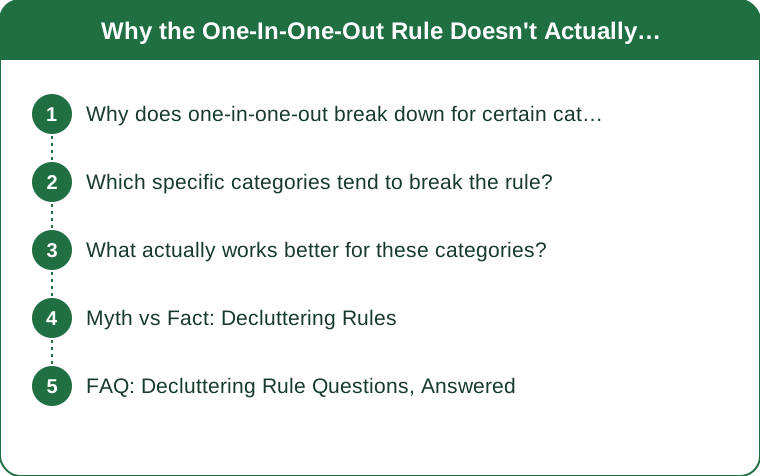
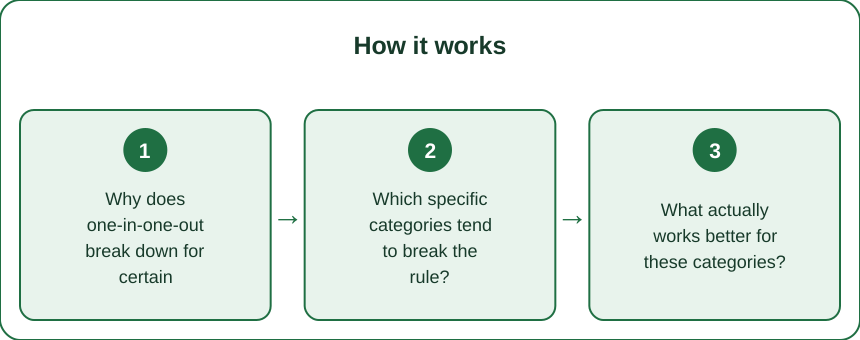
Why does one-in-one-out break down for certain categories?
The rule assumes a roughly 1:1 acquisition pattern — you buy a new sweater, so an old sweater leaves. But categories like paper mail, kids’ school papers and toys, or gifted items don’t follow a purchase-triggered pattern at all — they accumulate passively, in batches, often without you actively ‘bringing something in’ in a way that reminds you to take something out.
Which specific categories tend to break the rule?
1. Paper clutter — mail, receipts, school papers arrive constantly with no natural ‘out’ trigger tied to it.
2. Children’s items — toys, art, and clothes often arrive from gifts or hand-me-downs, not purchases you control.
3. Gifted or inherited items — these enter your home without any personal buying decision to pair with an removal.
4. Digital-adjacent physical clutter like cables, chargers, and manuals that accumulate from every gadget ever owned, rarely purchased in a way that maps to a clean swap.

What actually works better for these categories?
A scheduled purge instead of a transactional swap: pick a recurring time (weekly for paper, monthly for kids’ items, quarterly for gifted/inherited items) and process the whole accumulated batch at once, rather than waiting for a new-item trigger that may never come in a 1:1 pattern.
Myth vs Fact: Decluttering Rules
Myth: One rule should work for your entire home. Fact: Different categories accumulate differently, and matching the method to the accumulation pattern works better than forcing one universal rule everywhere.
Myth: Scheduled purges are less effective than continuous rules. Fact: For batch-accumulating categories, a scheduled purge actually catches more clutter than a swap rule that has no trigger to activate on.
Myth: If one-in-one-out isn’t working, you just need more discipline. Fact: The rule’s mismatch with certain accumulation patterns is a structural issue, not a willpower one — switching methods for those categories fixes it faster than trying harder at the same method.
FAQ: Decluttering Rule Questions, Answered
How do I know which method fits which category?
If the category enters your home through purchases you control, one-in-one-out works well; if it enters through mail, gifts, or other people’s decisions, use a scheduled purge instead.
How often should a scheduled purge happen?
Weekly for fast-accumulating categories like paper, monthly to quarterly for slower ones like gifted items — match frequency to how fast the pile grows.
Can I use both methods in the same home?
Yes — most well-organized homes use one-in-one-out for purchase-driven categories and scheduled purges for everything else simultaneously.
TL;DR:
- One-in-one-out assumes a purchase-triggered swap, which doesn’t fit passively-accumulating categories
- Paper, kids’ items, gifts, and cables/chargers are the most common rule-breakers
- Use a scheduled purge (weekly to quarterly, depending on speed of accumulation) for these instead
- The mismatch is structural, not a discipline problem — switch the method, not your effort level
One rule was never going to fit every category — matching the method to how the clutter actually enters your home is what makes decluttering finally stick.
Keep Reading
This article is for general informational and styling purposes only. Fit, sizing, and product availability may vary.