The Twenty Minute Activewear Audit That Actually Reduces the Pile
Quick Answer: Activewear decluttering works better with functional tests than with emotional ones. Four tests decide most items in seconds: the opacity test (hold it to light stretched), the recovery test (stretch the waistband and see if it returns), the smell test (persistent odour after washing means the fabric is done), and the six-week rule (if you have not reached for it in six weeks of normal training, you will not). No feelings required.
The drawer does not close, and half of what is in it has not been worn since spring.
The reason the usual decluttering advice does not work on activewear is that spark joy is a poor test for a legging. Function is a much faster one.

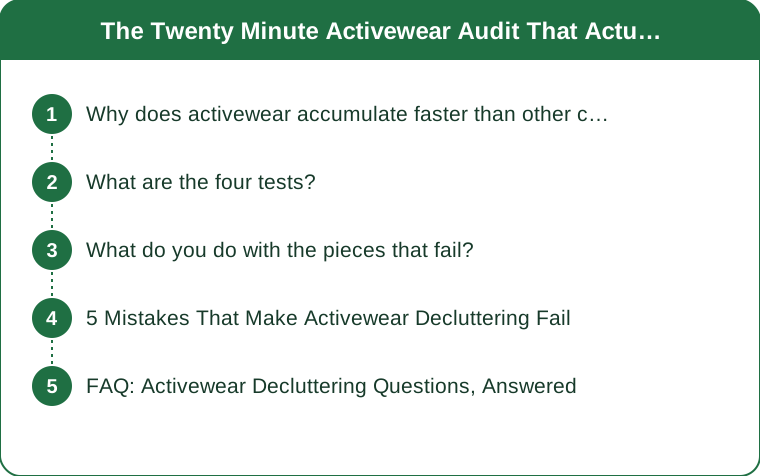
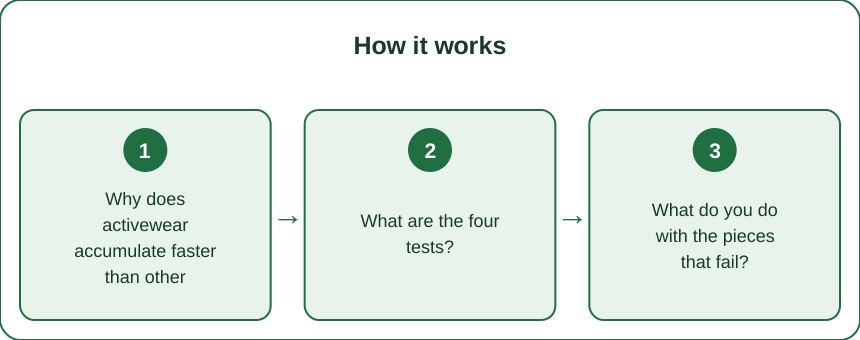
Why does activewear accumulate faster than other clothing?
Three structural reasons, and knowing them changes how you decide.
It is bought in sets and worn in fragments. Matching sets are sold as units and worn as separates, so you end up with an odd top or bottom whose partner has worn out. The orphaned piece stays because it is technically fine.
It fails invisibly. A worn-out t-shirt looks worn out. A legging that has lost its opacity looks identical to a new one on a hanger. The failure only appears under stretch and in bright light, which is why so many people own three pairs they never wear and cannot explain why.
It has enormous emotional stickiness. Aspirational purchases, expensive purchases, gift purchases, and pieces tied to a period when you trained differently. Activewear carries more of this than most categories because it is bound up with intentions about who you plan to be.
The consequence: a drawer where a large share of the volume is items you will never wear, protected by reasoning that has nothing to do with the garment.
Which is why functional tests work better. A legging that fails the opacity test is not wearable in public. That is a fact rather than a feeling, and it decides the question without negotiation.
What are the four tests?
All four are physical, fast, and require no reflection.
Test 1: The opacity test. Stretch the fabric over your hand or over your thigh, in bright natural light or under a phone torch. If you can see skin or the light clearly through it, it is not squat-proof any more.
This is the test people avoid because it disqualifies expensive pieces. Check the inner thigh and the seat specifically - those thin first. A legging that fails opacity is a home-only legging at best.
Test 2: The recovery test. Stretch the waistband out and let it go. It should snap back to its original dimension. If it returns slowly or does not fully return, the elastane has degraded and it will slide down every time you wear it. This is not fixable.
Same test on the leg fabric: stretch a section and release. Fabric that stays baggy has lost recovery.
Test 3: The smell test. Smell the underarms and the crotch on a freshly washed item. Persistent odour after washing means bacteria are embedded in the fibres - common in synthetics, and generally permanent once established. A vinegar soak or a sports detergent is worth one attempt. If it survives that, the garment is done.
Test 4: The six-week rule. If you have trained normally for six weeks and not reached for it, you will not. No reasoning required about why - the behaviour is the data. The exception is genuinely seasonal items, which need a full season to judge.
Most drawers resolve almost entirely on these four, in about twenty minutes.

What do you do with the pieces that fail?
Sort into four destinations rather than two, which is what makes the decision easier.
Keep in rotation. Passed all four tests and worn regularly.
Demote to home-only. Failed opacity but otherwise fine. This is a genuine category, not a way of avoiding the decision - lounging, home workouts, sleeping. The rule that makes it work: cap it. Four items maximum, and a new demotion means an old one leaves. Without a cap, demoted becomes a synonym for kept.
Donate or resell. Passed the functional tests but does not suit you. Wrong fit, wrong style, never comfortable. These are the easiest items to move on and the ones people hold longest, because they are still good. Good is not the same as worn.
Recycle or bin. Failed recovery or smell. These cannot be donated in good conscience - a charity shop cannot sell a legging with a dead waistband. Many activewear brands and some retailers run textile take-back schemes, and general textile recycling accepts worn synthetics.
The one rule that makes the whole thing work: decide the destination immediately and physically move the item. A maybe pile becomes the drawer again within a week - this is the single most common failure of every decluttering attempt.
Bags out of the house within 48 hours. A donation bag in the hallway for three weeks gets unpacked.
5 Mistakes That Make Activewear Decluttering Fail
1. Keeping things for the workout you do not do. Aspirational pieces for a sport you tried once. If the activity resumes, you will buy for it then, with better information about what you actually need.
2. Keeping expensive pieces that failed the tests. The money is already spent regardless of what you do now. A £90 legging that is see-through is worth exactly as much as a £15 one that is see-through. Price paid is not a functional test.
3. Creating a maybe pile. The most reliable way to end the session with the same amount of stuff. Every item goes to a destination on first handling.
4. Not capping the home-only category. Without a limit, demoting becomes keeping with extra steps. Four items, and one leaves when one arrives.
5. Doing it without bright light. The opacity test is meaningless in a dim bedroom. Do the whole audit near a window in daylight - it is the difference between a real assessment and a tidying session.
A bonus one that catches most people: doing it seasonally rather than when the drawer stops closing. The drawer not closing is the actual signal, and it arrives on its own schedule.
FAQ: Activewear Decluttering Questions, Answered
How many sets of workout clothes do I actually need?
Enough to cover your training frequency between washes, plus one. If you train four times a week and wash weekly, five sets. Most people own considerably more than this arithmetic requires, which is precisely the accumulation problem.
Can I fix leggings that have gone see-through?
No. Thinning happens through fibre abrasion and stretching, and there is no reversal. Preventing it is possible - cold wash, inside out, no fabric softener, air dry - but once it is thin it stays thin.
What about the smell that comes back mid-workout?
That is bacteria embedded in the fibres reactivating with heat and moisture. Try one round of a vinegar pre-soak or a sports-specific detergent. If it returns after that, the fabric is compromised permanently.
Should I donate activewear that is worn out?
Not if it has failed recovery or smell - charity shops cannot sell it and it becomes their disposal problem. Textile recycling is the right destination. Items that failed only the six-week rule are perfectly good to donate.
How often should I do this?
When the drawer stops closing, rather than on a calendar. That is the honest signal, and it usually arrives once or twice a year. Twenty minutes with the four tests handles it.
TL;DR:
- Functional tests beat emotional ones for activewear: opacity, recovery, smell, and six weeks unworn
- Stretch fabric over your hand in bright light - the opacity failure is invisible on a hanger
- A waistband that does not snap back has degraded elastane and cannot be fixed
- Persistent odour after washing means bacteria in the fibres; one treatment attempt, then done
- Four destinations, decided on first handling - a maybe pile rebuilds the drawer
- Cap the home-only category at four items or demoting just means keeping
Do it near a window. Half of what you own fails a test you have never run on it.
See It in Motion
Seen here: High Waist Yoga Leggings with Side Pockets — shop it on bubblelime.com
Keep Reading
This article is for general informational and styling purposes only. Fit, sizing, and product availability may vary.