The Counter Wars: Winning Back Your Kitchen's Most Contested Surface
Quick Answer: Kitchen counters collect clutter because everything needs somewhere to land and the counter is the most convenient surface available. Fix it with three moves: a single landing tray by the entry for keys and mail, an appliance rule (daily-use only stays out), and a 90-second nightly reset. Clear surfaces attract cleaning; cluttered ones attract more clutter.
Kitchen counters obey a law of physics nobody voted for: any flat surface attracts objects at a rate proportional to its convenience.
Mail, keys, a phone charger, three receipts, one mysterious battery. The counter collects it all, and winning this back is a systems problem rather than a discipline problem.

Why do kitchen counters attract clutter?
Because they sit at the intersection of two things: they’re the first flat surface you pass after the door, and they’re where you’re standing when you’re holding something and need a hand free.
The clutter isn’t a character flaw. It’s an unmet need for a landing place. People put things on the counter because the counter is there and nothing else is.
Which means scolding yourself is the least effective possible intervention. Give the objects somewhere better to go, and the counter stops being the default.
There’s also a compounding effect worth understanding: surfaces have momentum. One item on an otherwise clear counter looks wrong and tends to get moved. One item on a counter that already has six looks like it belongs there. The clutter recruits more clutter, which is why the state you leave the counter in each night largely determines the next day.
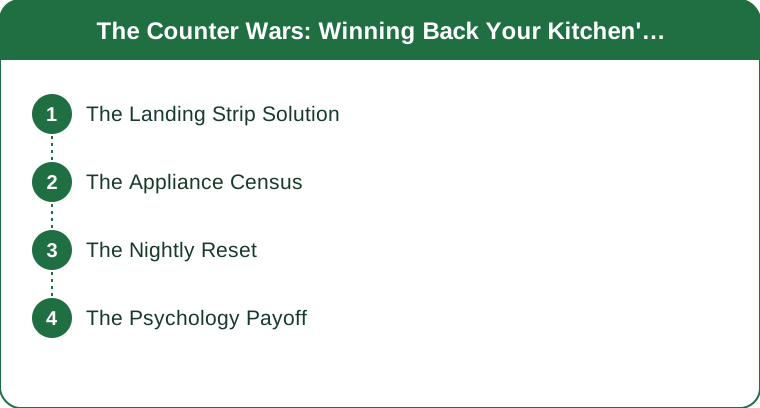
What is the landing strip solution?
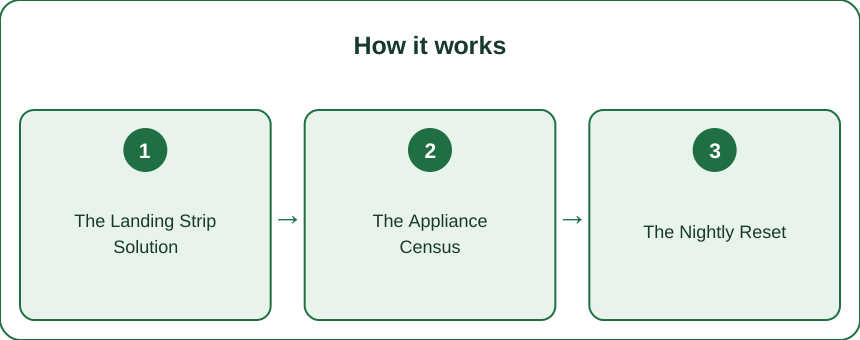
Give everything one designated place to land, ideally before the kitchen.
Set up a single tray or basket near the entry — keys, mail, pocket contents, sunglasses. One container, not three.
The pile still exists. That’s fine. The difference is that it now has borders, and borders can be emptied. An unbounded pile spreading across three feet of counter is a project. A full tray is a five-minute Sunday task.
Make it good enough to use. A tray that’s too small, awkwardly placed or ugly gets bypassed within a week. Slightly larger than you think, right where you naturally stop, and something you don’t mind looking at.
Add a mail rule. Open mail standing at the recycling bin. Junk goes in immediately; the rest goes in the tray. The reason mail becomes an archaeological layer is that it’s set down before it’s sorted, and it never gets sorted after.
Which appliances actually earn counter space?
Run a census, and be honest about frequency.
Daily use earns residency. Coffee maker, kettle, whatever you genuinely touch every single day.
Weekly or less lives in a cabinet. The blender, the stand mixer, the food processor, the air fryer you use on Sundays. Yes, it’s slightly less convenient. It’s also the difference between a functional counter and a cluttered one.
The toaster debate is yours to settle. Daily toast, keep it. Occasional toast, cabinet.
The honest test: count actual uses over the last two weeks. Not intended uses. If it was under five, it doesn’t live out.
The counter is for daily staff only. Everything else is a visitor with cabinet accommodation.
One more thing worth noting: an appliance you never see is an appliance you never use. If putting the blender away means you stop making smoothies, that’s a real cost — put it in the most accessible cabinet rather than the highest shelf.

What’s the nightly reset?
Ninety seconds after dinner. It’s the whole system, and everything else is support.
The sequence:
- Everything back to its home — dishes in the dishwasher, food away, tools in drawers.
- Tray contents dealt with if it’s overflowing (this is usually skipped and that’s fine).
- Wipe the counter clear, end to end.
That’s it. Under two minutes.
Why it works: you wake up to a clear surface, which means the day starts with the counter’s momentum pointed the right way. And a clear counter in the morning is dramatically easier to maintain than a cluttered one — you’re defending a clean surface rather than excavating a dirty one.
Make it a trigger, not a decision. Tie it to something that already happens: after the dishwasher is loaded, after the last person eats, while the kettle boils. A reset that requires deciding to do it will lose the negotiation on tired evenings.
5 Mistakes Everyone Makes With Kitchen Counters
- Buying organizers before decluttering. Containers for things you shouldn’t be keeping just makes the clutter tidier and permanent. Sort first, contain second.
- Creating too many landing spots. Three trays in three rooms means nothing ever gets fully processed. One landing strip, emptied weekly.
- Doing a big clear-out with no maintenance system. A two-hour Saturday reorganization without a nightly reset returns to baseline in about eleven days.
- Keeping appliances out “so I’ll use them.” This almost never works. What determines use is whether the recipe is in your routine, not whether the machine is visible.
- Storing things on the counter because the cabinets are full. That’s a cabinet problem wearing a counter costume. If the counter is overflowing, the actual fix is usually inside the cupboards.
What’s the payoff?
More than aesthetics, though the aesthetics are nice.
Visual clutter competes for attention — there’s a reasonable body of research linking cluttered environments to higher perceived stress, particularly in the spaces people associate with unfinished tasks. And the kitchen is essentially a room made of unfinished tasks.
A clear counter reads as a calm kitchen, which reads as a calm morning. You’re not cleaning for hypothetical guests. You’re lowering tomorrow’s stress tonight, with a sponge, in 90 seconds.
There’s also a practical dividend: clear counters make cooking easier, which makes cooking more likely, which is quietly one of the better health interventions available to most households.
FAQ
How do I keep my kitchen counters clear permanently?
The nightly 90-second reset is the mechanism. One-off decluttering doesn’t hold; a daily habit that returns the surface to zero does. Pair it with a landing tray by the entry and a daily-use-only rule for appliances.
What should I keep on my kitchen counter?
Only what you use every day — typically a coffee maker or kettle, a knife block or utensil crock, and a cutting board if you cook daily. Everything else belongs in a cabinet.
Why do my counters get cluttered again so fast?
Almost always because there’s no landing place for the incoming items (keys, mail, bags) and no nightly reset. Those two gaps rebuild the pile within days no matter how thorough the initial clear-out was.
TL;DR:
- Clutter lands on counters because everything needs somewhere to land. Give it a better place.
- One landing tray by the entry, emptied weekly. Borders make piles manageable.
- Daily-use appliances only stay out. Under five uses in two weeks means cabinet.
- The 90-second nightly reset is the whole system. Tie it to an existing trigger.
- Surfaces have momentum — clear counters stay clear, cluttered ones recruit more.
Keep Reading
This article is for general informational and styling purposes only. Fit, sizing, and product availability may vary.