Clear the Entryway Now, Before Six Weeks of Coats and Boots Arrive
Quick Answer: Work by category rather than by location, remove everything that belongs to another season, and then set a hard capacity limit - one coat hook and one pair of shoes per person at the door. The entryway fails in autumn because incoming volume roughly doubles while storage stays the same, so capacity, not tidiness, is the actual constraint.
Most entryway systems fail within three weeks. The ones that survive have a fixed capacity and a weekly reset, not a clever product.

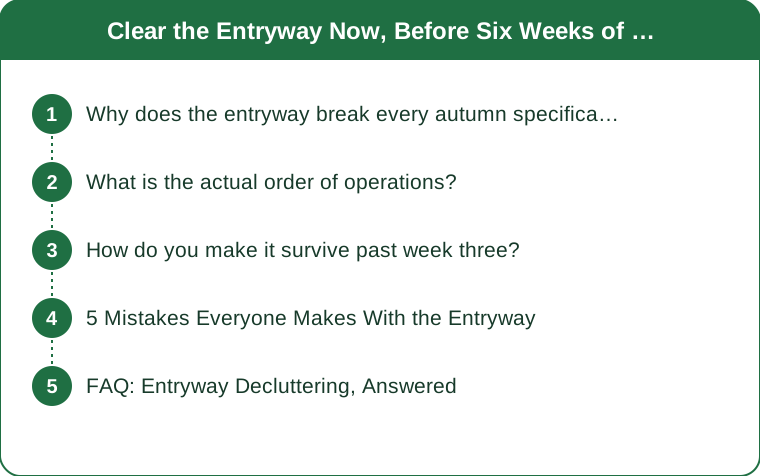
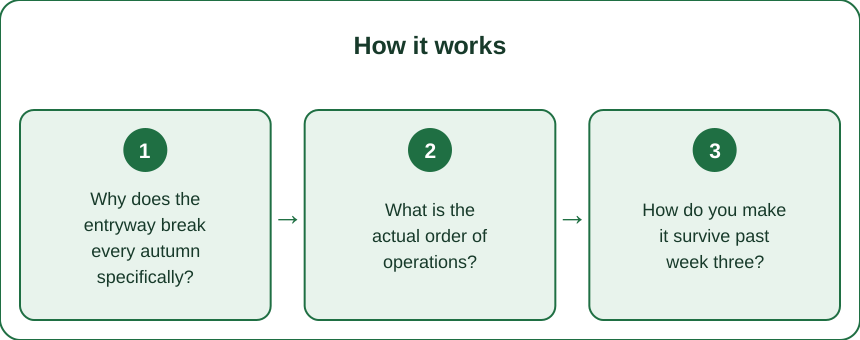
Why does the entryway break every autumn specifically?
Because the volume of things that pass through it doubles while the space does not change.
What arrives between September and November:
- Coats and jackets, which take roughly four times the hanging space of summer layers
- Boots and closed shoes, replacing sandals that stacked flat
- Umbrellas, scarves, hats, gloves
- School bags, sports kit and the associated equipment
- Wet items that need somewhere to dry
The arithmetic problem. A hallway sized for two jackets and four pairs of shoes is asked to hold six jackets, ten pairs and a pile of accessories. No organizing system fixes a capacity shortfall - it just changes the shape of the overflow.
The three failure modes, in order of frequency:
- The horizontal surface. Any flat surface near the door becomes a landing pad, and once it has three things on it, it has twenty within a fortnight
- The floor pile. Shoes stop going away because putting them away takes 15 seconds and there is nowhere obvious
- The overloaded hook. Four coats on one hook means none of them are accessible, so the fifth goes on the floor
Why it matters more than other rooms. The entryway is the first and last thing you see every day. It sets the tone in a way its square footage does not justify, and a chaotic entry adds friction to leaving the house - which is exactly what you cannot afford on an autumn morning.
Which points to the real goal. Not a beautiful entryway. An entryway with enough capacity for winter volume, with a system simple enough to work in ten seconds while holding a bag.
What is the actual order of operations?
Empty, sort by category, cut to capacity, then assign homes. In that order.
Step 1: Empty it completely, 15 minutes. Everything out, onto the floor of the next room. You cannot assess capacity while things are in place - the existing arrangement anchors your judgment about what belongs.
Step 2: Sort by category, not by owner or by keep-or-toss. Shoes together, coats together, bags together, accessories together, and one pile for things that never belonged here.
- The other-room pile is usually the largest, and this alone often solves the problem
- Sorting by category makes duplicates visible. Four black umbrellas do not look like four until they are next to each other
Step 3: Set capacity before deciding what to keep. Count your hooks and your shoe slots. That number is your limit, and it is not negotiable - this is the step that separates a declutter that lasts from one that does not.
- One coat per person at the door, current season only
- One or two pairs of shoes per person, the ones actually worn daily
- Everything else lives in a bedroom or a closet
Step 4: Assign a specific home to each remaining category. Not a general area - a specific place. Keys in a bowl, not near the door. Post in a tray, not on the shelf. Vagueness is where systems fail.
Step 5: Deal with the off-season items immediately, in the same session. Summer shoes and light jackets go into storage now. If you leave them for later, later is December.
Realistic timing: 60 to 90 minutes for a typical entryway, of which the sorting is 20 minutes and the deciding is everything else.

How do you make it survive past week three?
A capacity limit and a weekly reset, both of which are boring and both of which are the entire answer.
The capacity limit does the heavy lifting. When hooks are full, the coat has to go elsewhere, and the decision happens at the moment of arrival rather than accumulating for a month. A system with slack in it will fill the slack.
- Remove hooks rather than adding them if overflow is chronic. Counterintuitive and effective
- A shoe rack with a fixed number of slots outperforms an open floor area by a wide margin, because the limit is visible
The weekly reset, five minutes:
- Pick a fixed time - Sunday evening works for most households
- Return everything that has migrated, take the accumulated post to where post lives, put stray shoes away
- Five minutes weekly prevents the two-hour reset, and the ratio is what makes it worth doing
Design decisions that reduce the effort required:
- Hooks at child height if children live there. A hook a child cannot reach is a hook that does not get used, and the coat lands on the floor
- A basket, not a shelf, for anything that has no natural order - gloves, hats, dog leads. Baskets tolerate disorder; shelves display it
- A boot tray, which is the single highest-value autumn purchase for an entryway. It contains the mess and makes wet shoes acceptable
- A mirror by the door, which sounds cosmetic and actually stops people carrying things back in from the car
Preparing for the volume that is coming:
- Add an over-door hook rack for the peak weeks, which can be removed in spring
- Set aside one drawer or bin for accessories before you need it. Hats and gloves arrive suddenly and with no assigned home
- Store the summer items somewhere you can reach, since early autumn still delivers warm days
5 Mistakes Everyone Makes With the Entryway
1. Buying storage first. The near-universal instinct, and it converts a capacity problem into a capacity problem with more furniture. Cut first, then buy only what the remaining items need.
2. Keeping off-season items in reach. Summer sandals in the autumn shoe rack take slots the winter boots need. Moving them takes ten minutes and returns a quarter of the space.
3. Storing every family member’s outerwear at the door. The entryway holds what is in use today, not the full wardrobe. One coat each, current season.
4. Creating a landing surface. A console table, a shelf, a bench top - any horizontal surface near the door becomes a dumping ground within weeks. If you must have one, put a tray on it, because a bounded surface fills far more slowly than an unbounded one.
5. Doing a huge reorganization and no maintenance. A perfect entryway with no weekly reset is a chaotic entryway in six weeks. The five-minute weekly habit matters more than the initial 90 minutes, and it is the part almost everyone skips.
The common thread: entryway problems are flow problems, not storage problems. Things pass through faster than they get put away, and the fix is at the rate rather than the volume.
FAQ: Entryway Decluttering, Answered
How long does an entryway declutter actually take?
About 60 to 90 minutes for a typical entryway. Sorting takes 20 minutes; the rest is deciding and assigning homes.
Should I buy storage before or after decluttering?
After, always. Buying first means storing things you would have removed, and it converts a capacity problem into a furniture problem.
How many coats and shoes should live at the door?
One coat and one to two pairs of shoes per person, current season only. Everything else belongs in a bedroom or closet.
Why does my entryway get messy again so fast?
Because there is slack in the system and the flow through it is high. A fixed capacity plus a five-minute weekly reset is what makes it stick.
What is the best single purchase for autumn?
A boot tray. It contains wet and muddy shoes, which is the specific problem autumn introduces, and it makes the floor pile acceptable rather than chaotic.
What do I do about the pile of post and packages?
Give it a bounded container - a tray or a single basket - and empty it on the weekly reset. Bounded surfaces fill far more slowly than open ones.
TL;DR:
- The entryway fails in autumn because incoming volume doubles while storage stays fixed - it is a capacity problem
- Empty it, sort by category, set capacity before deciding what stays, then assign specific homes
- One coat and one to two pairs of shoes per person at the door, current season only
- Buy storage last, never first; remove hooks rather than adding them if overflow is chronic
- A five-minute weekly reset matters more than the initial 90 minutes
Do it now, in the six weeks before the coats and boots arrive. Doing it in November is doing it under load.
Keep Reading
This article is for general informational and styling purposes only. Fit, sizing, and product availability may vary.