How to Declutter When Your Partner Doesn't Want to Get Rid of Anything
Quick Answer: When partners disagree about decluttering, the most effective approach is dividing shared space into individually-owned decision zones (each partner fully controls decluttering their own items) plus genuinely shared items that require mutual agreement, rather than one partner pushing to declutter items the other person feels attached to.
Decluttering advice assumes you have full authority over every item in your space. That assumption falls apart fast when you share a home with someone who doesn’t want to let go of things you’d happily toss.

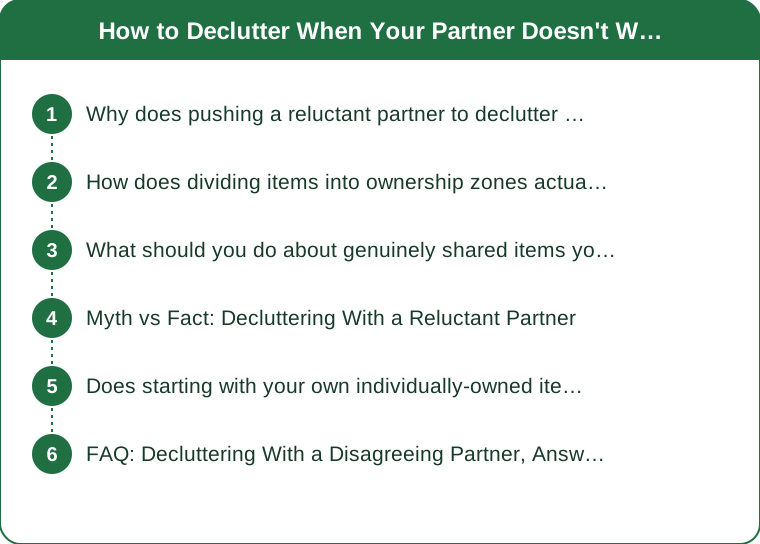
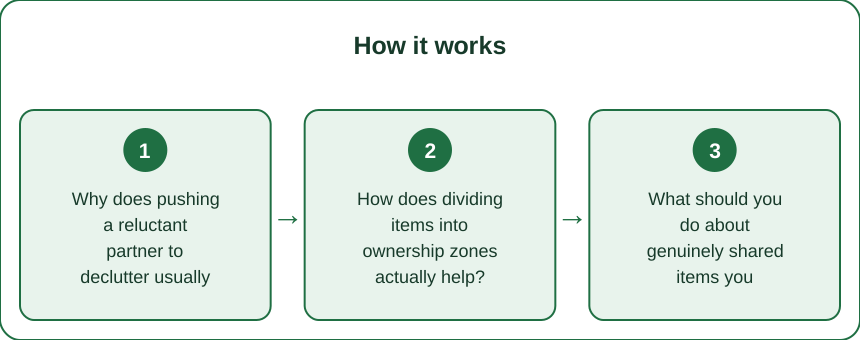
Why does pushing a reluctant partner to declutter usually backfire?
Pushing someone to get rid of items they’re attached to tends to create defensiveness and conflict that has little to do with the actual clutter, and often results in the reluctant partner holding onto items even more firmly as a reaction to feeling pressured, rather than genuinely reconsidering whether they need them.
How does dividing items into ownership zones actually help?
Clearly separating items that are individually owned (clothing, hobby items, personal belongings) from genuinely shared items (furniture, shared kitchen items, joint decor) lets each partner fully control decisions about their own things without needing buy-in, while reserving negotiation only for the smaller category of items that actually require mutual agreement.
What should you do about genuinely shared items you disagree on?
For shared items, a useful approach is taking turns deciding rather than requiring full agreement on every single item — one partner gets final say on a subset of shared decluttering decisions this round, the other partner gets the next round, which avoids constant negotiation fatigue over every individual item.

Myth vs Fact: Decluttering With a Reluctant Partner
Myth: A cluttered shared space always means one partner needs to change. Fact: Different comfort levels with possessions are normal, and a workable system accommodates both rather than requiring one person to adopt the other’s standard.
Myth: Compromise means meeting exactly in the middle on every item. Fact: Dividing decision authority by ownership, rather than negotiating every item individually, is often more sustainable than constant compromise.
Does starting with your own individually-owned items first help the overall process?
Yes — decluttering your own space first, without asking anything of your partner, often reduces defensiveness because it removes the sense that decluttering is being imposed on them. Some partners become more open to decluttering their own items after seeing the process modeled without pressure.
FAQ: Decluttering With a Disagreeing Partner, Answered
What if shared space feels overwhelmed by one partner’s belongings specifically?
A direct, non-accusatory conversation about space allocation — rather than a decluttering conversation — often addresses this more effectively.
Should you ever declutter a partner’s belongings without asking?
No — this reliably damages trust and should be avoided regardless of how justified it might feel in the moment.
Is professional mediation or organizing help worth it for persistent disagreement?
For significant, ongoing conflict, a neutral third party (professional organizer or counselor) can sometimes reframe the conversation more productively than partners can alone.
TL;DR:
- Pushing a reluctant partner to declutter usually increases resistance, not progress
- Dividing items into individually-owned vs. shared zones reduces unnecessary conflict
- Taking turns on shared-item decisions avoids negotiating every single item
- Decluttering your own space first, without pressure, often models a better process
If decluttering has become a recurring argument, try mapping out ownership zones this week before tackling another item-by-item negotiation.
Keep Reading
This article is for general informational and styling purposes only. Fit, sizing, and product availability may vary.