Decluttering a Home That Is Also an Office — The Zone Problem
Quick Answer: Standard decluttering sorts by category — all the books, all the papers. That fails when you work from home because the real problem is not too many items, it is items with no assigned zone drifting between work mode and life mode. Sort by zone and by time-of-day use instead, and give every work item a single “closed” home it returns to at the end of the day.
You tidied the whole apartment on Sunday. By Wednesday afternoon there are three coffee cups, a charger, two notebooks, and a stack of mail on the same table.
This is not a discipline failure. It is a zoning failure, and it is specific to homes that are also workplaces.

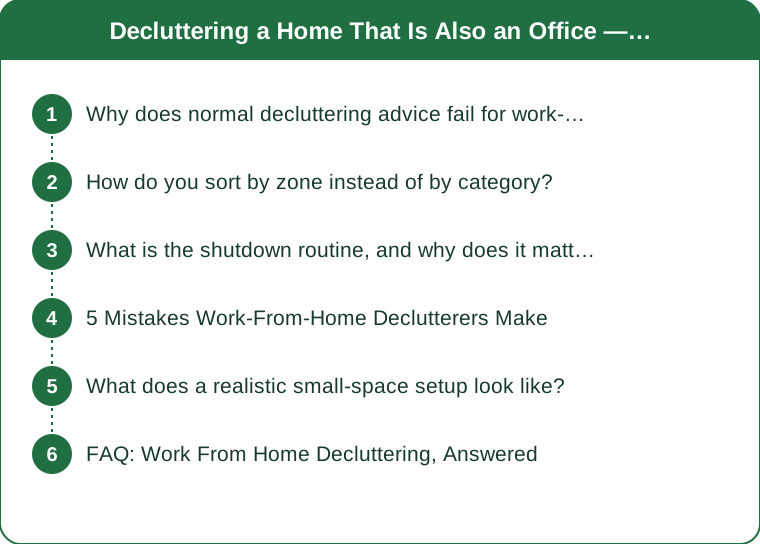
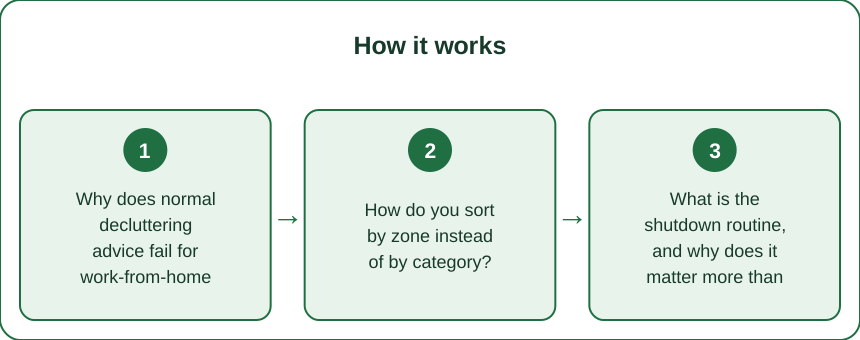
Why does normal decluttering advice fail for work-from-home spaces?
Because the standard method assumes every item has one context.
Conventional advice says gather everything in a category, decide what to keep, and assign homes. That works beautifully for clothes and books, where an item belongs to one part of your life.
Work-from-home clutter is different in three specific ways:
Items live in two modes. The dining table is a desk from 9 to 5 and a table at 7. The laptop charger belongs on the table and also in the bag. There is no single correct home, so items end up with no home at all and simply stay wherever they were last used.
The volume regenerates daily, not seasonally. A closet declutter holds for a year. A work surface regenerates its clutter in about three days, because you keep producing new papers, cups, cables, and notes. Any solution that requires a big effort is structurally doomed — it will be undone before you do it again.
Mode-switching is the actual problem, and it is psychological. The reason work clutter bothers you more than other clutter is that it prevents your space from changing modes. Seeing your work laptop at dinner keeps you in work mode. The clutter is not just visually messy; it is preventing the room from doing its second job.
That third point is why the fix is not about owning less. It is about being able to close the workday.
How do you sort by zone instead of by category?
Walk your space and define zones by what happens there and when, not by what the room is called.
Step 1 — Name your zones out loud. In a small apartment, you might have: work surface, eat surface, wind-down surface, and drop zone by the door. In a house it might be more. Naming them is not decoration — you cannot assign homes without named destinations.
Step 2 — For each item on a surface, ask which zone it belongs to. Not “do I love this” or “have I used it in a year.” The question is “which zone is this item’s home?” Items that belong to no zone are the whole problem, and they are typically 60 to 80 percent of the visible mess.
Step 3 — Give every homeless item a zone, or remove it. This is where the work is. A charger that lives nowhere ends up everywhere. A charger that lives in a specific drawer in the work zone can be put away in three seconds.
Step 4 — Create one closed container per zone for the daily regeneration. A basket, a drawer, a lidded box. Everything the day produced that belongs to that zone goes in there at the end of the day. Closed matters — an open tray becomes visual clutter itself, and a lid is what lets the room change modes.
Step 5 — Handle the cross-zone items explicitly. The laptop, the notebook, the water bottle. These genuinely move, so their home is a transit container — a specific bag, tray, or shelf that they return to, rather than a fixed spot.
The sorting question that does the most work: “where does this go when the workday ends?” If you cannot answer instantly, that is the item creating your clutter.
What is the shutdown routine, and why does it matter more than the decluttering?
A five-minute end-of-day reset does more for a work-from-home space than any organizing project.
The routine, in order:
- Everything work-related goes into its closed home — laptop in the drawer or bag, papers in the box, notebook closed and stacked.
- Cups and plates go to the kitchen. All of them. This alone is usually half the visible clutter.
- Cables coiled and put away, or clipped to their permanent spot. Loose cables read as chaos out of proportion to their size.
- Wipe the surface. Twenty seconds, and it is the step that makes the space feel genuinely reset rather than merely cleared.
- Reset the room to its evening mode — chair pushed in, lamp on, whatever signals “not work” in your space.
Why this beats a bigger organizing effort: the clutter regenerates daily, so the maintenance interval has to be daily. A five-minute daily reset is sustainable in a way that a two-hour Saturday reorganization is not, and the two-hour version gets undone by Wednesday regardless.
Why it matters beyond appearance: the shutdown routine is one of the most consistently recommended tools for separating work from home life when they share a space. The physical act of putting work away is what tells your brain the day ended. People who work from home without a shutdown ritual commonly report that work feels never-finished — and the clutter is both a cause and a symptom of that.
Make it easy or it will not happen. If putting the laptop away requires unplugging four things and walking to another room, you will not do it on a tired Thursday. The container should be within arm’s reach of where you work.

5 Mistakes Work-From-Home Declutterers Make
Mistake 1: Organizing the work zone without giving work a boundary. A beautifully organized desk that stays fully visible all evening still keeps you in work mode. The goal is not a photogenic desk; it is a desk that can disappear. Closed storage beats attractive open storage for this specific purpose.
Mistake 2: Treating the dining table as a temporary desk. If you have worked at the dining table for more than a month, it is your desk. Set it up as one — with a real chair, a defined storage spot, and a shutdown routine — rather than pretending each day that the arrangement is temporary. Half-committed setups generate the most clutter because nothing has a designated place.
Mistake 3: Buying organizing products before defining zones. Containers without assigned zones just become nicer-looking piles. Define where things live first, then buy the container that fits that specific job. Most people do it in the opposite order and end up with organized clutter.
Mistake 4: Doing one big declutter and expecting it to hold. Work clutter regenerates on a three-day cycle. The system that matters is the daily five minutes, not the Saturday project. If you only have energy for one, choose the daily one.
Mistake 5: Not accounting for the paper you cannot throw away yet. Every work-from-home setup generates papers in an in-between state — needed soon, not needed now. Without a specific “pending” home, these end up in the most visible spot in the house. One labeled folder or tray for in-progress paper solves a surprisingly large share of desk clutter.
What does a realistic small-space setup look like?
Constraints make this harder and also simpler — fewer zones, clearer choices.
In a studio or one-bedroom:
- One closed container holds the entire work setup. A lidded box, a rolling cart with a cover, or a deep drawer. Everything work-related lives there overnight. This is non-negotiable in a small space, because there is nowhere for visual clutter to hide.
- The work surface must fully clear. If your desk cannot be emptied in under five minutes, the setup is too large for the space.
- Go vertical for storage, since floor space is the scarce resource. A wall shelf above the work area holds far more than any surface arrangement.
- One drop zone by the door, and it should be small enough to force decisions. A generous entry table becomes a permanent pile.
What to actually reduce, if you are cutting volume:
- Duplicate cables and chargers — most people have several times what they need
- Paper that exists digitally elsewhere, which is most of it
- Pens and notebooks past what you use in a month
- Anything from a job or project that ended
- Books and reference material you have not opened in a year and could find online in ten seconds
What not to reduce: things that make the space work as a home. The instinct to strip a small space bare backfires — a room that is only functional is unpleasant to live in for the 16 hours a day you are not working. Keep the plant, the art, and the good lamp. They are what makes the space read as home when the laptop is put away, which is the entire goal.
FAQ: Work From Home Decluttering, Answered
I do not have a separate room. Where do I start?
With the shutdown routine, before anything else. Even in a shared space, putting work away at a fixed time each day does more than reorganizing ever will. Then find one closed container that holds the whole setup.
How do I stop the dining table becoming a desk?
Usually you cannot, and fighting it wastes energy. Accept it as the desk, and invest in the shutdown routine so it converts back reliably at the end of the day.
How often should I do a full declutter of the work area?
Once a quarter is plenty if the daily reset is happening. If you find yourself needing a full reset monthly, the daily routine has lapsed or your storage is in the wrong place.
What about all the paper?
Three destinations, decided at the moment it arrives: act on it, file it, or recycle it. The fourth pile — “deal with later” — is where desk clutter comes from. If you must have a pending pile, give it one labeled folder and empty it weekly.
TL;DR: Work-from-home clutter is a zoning problem, not a volume problem.
- Sort by zone and time-of-day use, not by category. Category sorting assumes one context per item, which is exactly what fails here.
- The real culprits are items with no assigned home — typically most of what is on your surfaces.
- Every zone needs one closed container for the daily regeneration. Closed matters, because it lets the room change modes.
- A five-minute daily shutdown routine beats any big organizing project, because work clutter regenerates in about three days.
- Give in-progress paper one labeled home. The “deal with later” pile is where most desk clutter originates.
- Do not strip a small space bare. The plant and the lamp are what make it read as home when work is put away.
Start with the shutdown routine tonight. Five minutes, same time, everything work-related into one closed spot.
Keep Reading
This article is for general informational and styling purposes only. Fit, sizing, and product availability may vary.