Why the Order You Declutter Rooms In Actually Matters for Decision Fatigue
Quick Answer: Decluttering decision fatigue builds cumulatively across a session, so starting with low-emotional-stakes items (a linen closet, a pantry) before moving to higher-stakes categories (sentimental items, clothing) preserves decision-making capacity for the harder calls. Starting with the hardest room first often leads to rushed, regretted decisions later in the same session.
The same closet can get decluttered thoughtfully or carelessly depending on whether it’s tackled first or fourth in a session - decision fatigue, not motivation, is usually the actual variable.

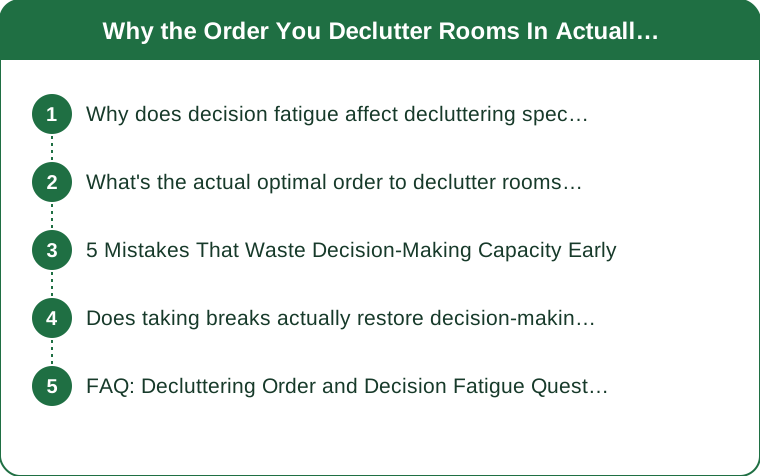
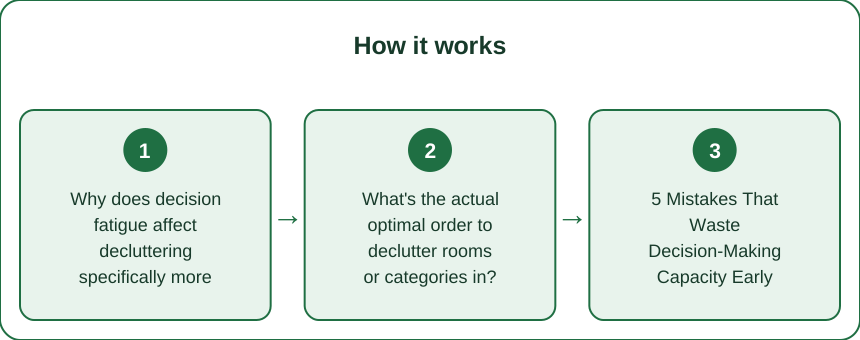
Why does decision fatigue affect decluttering specifically more than other tasks?
Every single item requires a keep-or-let-go decision, and each decision draws from the same finite mental resource - by the 40th or 50th decision in a session, judgment quality measurably declines, according to how decision fatigue is generally understood to work across various decision-heavy tasks. This is why the same person can make thoughtful choices about the first drawer and rushed, regretted choices about the fifth.
Decluttering is particularly vulnerable to this because unlike many repetitive tasks, each item can carry emotional weight (memories, guilt about cost, uncertainty about future need) that adds cognitive load beyond a simple physical sorting task.
What’s the actual optimal order to declutter rooms or categories in?
Start with low-emotional-stakes, high-clarity categories - a linen closet, kitchen tools, a bathroom cabinet - where keep-or-toss decisions are usually quick and low-stakes. Move toward moderate-stakes categories next (general clothing, books), saving the highest-stakes categories (sentimental items, gifts, clothing tied to a specific memory or life stage) for when you’re fresh, ideally a separate session entirely rather than the tail end of a long decluttering day.
This sequencing preserves your best decision-making capacity for the categories that genuinely need it, rather than spending that capacity on easy decisions and reaching the hard ones already depleted.

5 Mistakes That Waste Decision-Making Capacity Early
1. Starting with sentimental items “to get the hard part over with,” which front-loads your highest-cognitive-load decisions before fatigue has even set in, then leaves easier categories to be rushed later anyway. 2. Decluttering for many hours in one sitting, when 90-120 minute sessions with breaks preserve decision quality better than a single exhausting marathon. 3. Making big keep/donate decisions while multitasking (watching TV, half-listening to a call), which further taxes an already limited decision-making resource. 4. Not setting a simple default rule in advance (like “if unused in 12 months, it goes”), forcing a fresh full evaluation for every single item instead of a quick rule-based check. 5. Decluttering when already mentally taxed from an unrelated stressful day, which starts the session with reduced capacity before the first item is even touched.
Does taking breaks actually restore decision-making capacity mid-session?
Yes - a genuine break (10-15 minutes, away from decision-making entirely) does measurably restore some decision-making capacity, which is part of why splitting decluttering into shorter sessions across several days tends to produce better, less regretted outcomes than one long push through an entire house.
A break spent on a low-decision activity (a short walk, a snack, checking messages) restores capacity better than a break spent on another decision-heavy task, since the fatigue is specifically tied to decision-making, not general tiredness or physical effort.
FAQ: Decluttering Order and Decision Fatigue Questions, Answered
Does this mean I should never declutter sentimental items in the same day as other categories?
Not necessarily never - just plan sentimental categories for the beginning of a fresh session rather than the end of a long one, when your decision-making capacity is highest, not lowest.
How do I know if I’m experiencing decision fatigue mid-session?
Common signs include reaching for “maybe” piles more often, feeling irritated by simple decisions that felt easy earlier, or wanting to just keep everything to avoid deciding - these are good signals to take a break.
Does having a decluttering partner help with this fatigue pattern?
Somewhat - a second person can catch when your judgment seems to be slipping and suggest a break, though the underlying fatigue mechanism still applies to whoever is making the actual keep-or-toss calls.
TL;DR:
- Decision fatigue builds cumulatively across a decluttering session, reducing judgment quality over time
- Start with low-stakes categories and save sentimental items for a fresh session
- 90-120 minute sessions with real breaks outperform single long marathons
- Setting a simple default rule in advance reduces the decision load per item
The order you declutter in isn’t a minor detail - it determines whether your hardest decisions get your best judgment or your most depleted judgment.
Keep Reading
This article is for general informational and styling purposes only. Fit, sizing, and product availability may vary.