The Bathroom Cabinet Audit: What Has Actually Expired and What Has Not
Quick Answer: The bathroom is the one room where decluttering has an objective standard — most of what is in there has an expiry date, and roughly half of a typical cabinet is past it. Sunscreen, prescription medication and anything with active ingredients genuinely degrade. Shampoo, most soaps and unopened sealed products largely do not. Sort by expiry first and the emotional decisions mostly disappear.
Decluttering usually runs into the question of whether you might want something later, which is unanswerable and is why so many decluttering sessions stall halfway.
Bathrooms are different. Most of what is in there has a date on it, and once you start sorting by date rather than by feeling, the job takes forty minutes instead of a whole Saturday.
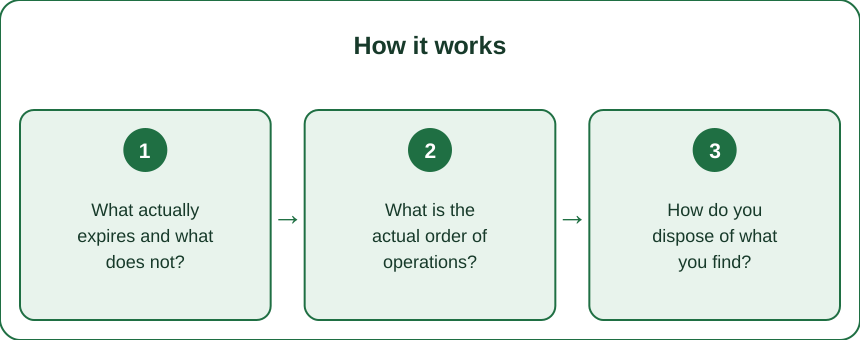
What actually expires and what does not?
The categories are clearer than the marketing suggests.
Genuinely expires and matters:
- Sunscreen — degrades and loses effectiveness, typically rated for 3 years unopened or the printed date. Expired sunscreen offering unknown protection is worse than no sunscreen, because you behave as though you are protected.
- Prescription medication — some lose potency, a few become genuinely problematic. Antibiotics and anything liquid should go on the date.
- Retinoids, vitamin C serums, benzoyl peroxide, hydrogen peroxide — active ingredients that oxidise. A vitamin C serum that has gone brown or orange has already converted and is doing nothing.
- Anything for the eyes — mascara at 3 months after opening, eye drops on the date, no exceptions. This one is a genuine infection risk rather than a marketing convention.
- Sponges, loofahs and makeup sponges — not an expiry issue but a bacterial one. Replace loofahs every 3 to 4 weeks.
Largely does not expire:
- Bar soap, unopened shampoo and conditioner, petroleum jelly, most unopened sealed skincare, epsom salts, cotton products.
The PAO symbol — the small open-jar icon with a number like 12M — is the period after opening, and it is the number that matters for anything you have already started. Write the opening date on the bottom with a marker when you open something and this becomes trivial.
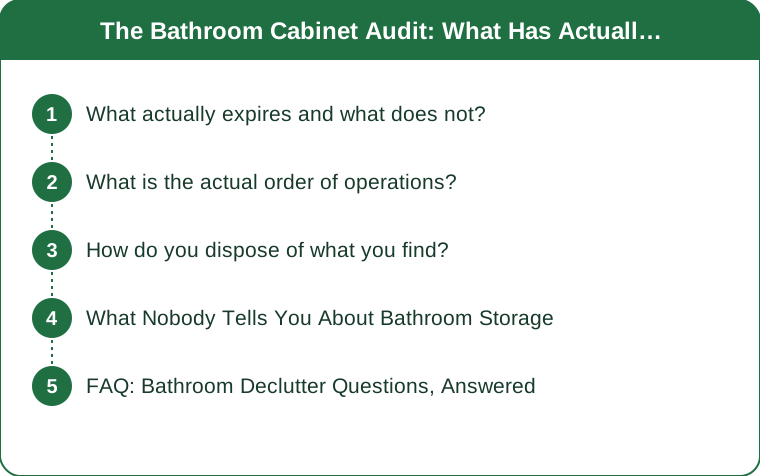
What is the actual order of operations?
Order matters more than technique here, because the point is to avoid the decision fatigue that stalls the job.
Step 1: Empty everything onto a towel on the floor. All of it, including the back of the cabinet. You cannot audit what you cannot see, and the back of the cabinet is where the expired half lives.
Step 2: Sort by date only. Three piles: expired, in date, no date visible. Do not think about whether you like something yet. This step should take ten minutes and requires no judgement.
Step 3: Deal with the expired pile immediately. Bin it or bag it for disposal before you start second-guessing. This is the step people skip and it is the step that makes the whole thing work.
Step 4: Now sort the in-date pile by whether you have used it in the last 90 days. Products you have not touched in three months in a bathroom you use daily are not going to get used.
Step 5: Clean the empty cabinet, then put back only what survived. The cleaning step matters psychologically — an empty clean shelf makes you reluctant to refill it with things you do not need.
Step 6: Group by use, not by type. Everything you use in the morning together, everything for evening together. Sorting by category (all skincare, all haircare) looks tidier and functions worse.
How do you dispose of what you find?
This is the part that stops people mid-job, so it is worth knowing before you start.
Medication should not go in the bin or the toilet. Most pharmacies run take-back programmes, and many US locations have permanent drop-off boxes. The DEA runs national take-back days twice a year. If nothing is available, the accepted home method is mixing pills with something unappealing like used coffee grounds in a sealed bag before binning.
Aerosols — hairspray, dry shampoo — are pressurised and go to household hazardous waste, not curbside recycling, unless completely empty.
Nail polish and remover are classed as hazardous waste in most municipalities.
Cosmetics and skincare generally go in the bin, but the packaging often does not. Glass jars and many plastic bottles recycle if rinsed. Pumps and droppers usually do not — they are mixed materials.
Unopened, in-date, unwanted products can often be donated. Shelters and domestic violence services frequently accept unopened toiletries, though not opened cosmetics or medication. Check locally before you fill a bag.
A realistic expectation: a first-time bathroom audit on a cabinet that has not been touched in a few years typically produces one full bin bag plus a small hazardous waste pile. That is normal, not a personal failing.
What Nobody Tells You About Bathroom Storage
The bathroom is the worst room in the house for storing most of what people store there.
Heat and humidity degrade products faster than the printed dates assume. Expiry testing is done at controlled room temperature. A cabinet next to a shower that runs twice a day sits at high humidity and elevated temperature for hours daily, and that accelerates degradation of anything with an active ingredient.
The practical implication is unwelcome: medication and actives should not live in the bathroom at all. A bedroom drawer or a linen closet is meaningfully better for anything you care about keeping potent. The medicine cabinet is a naming accident, not a recommendation.
The back of the shelf is a black hole. Anything more than one row deep is functionally invisible. If your cabinet is deep, use small containers as drawers so the back row can be pulled forward, or accept that you will buy duplicates of whatever lives back there.
Duplicates are the clearest signal. If the audit turns up three half-empty bottles of the same thing, that is not a shopping problem — it is a visibility problem. You bought a second one because you could not see the first.
The seasonal moment matters too. Late August is a natural point for this job, because summer products — sunscreen, after-sun, insect repellent — are about to go into storage for six months. Sunscreen bought this summer will likely expire before next summer’s peak, and knowing that now is more useful than discovering it in June.
FAQ: Bathroom Declutter Questions, Answered
How often should I do this?
A full audit twice a year is plenty — the seasonal changeovers in spring and early autumn are natural prompts. A five-minute check of the front row monthly stops the back row from filling up again.
What if there is no date on the product?
Use the PAO symbol if there is one. If neither exists, apply a rough rule: 12 months for anything opened with active ingredients, 2 to 3 years for basic products like shampoo. When genuinely unsure, smell it and look at it — separation, colour change or an off smell is a clear answer.
Is expired makeup actually dangerous?
Eye products, yes — bacterial contamination near the eye is a real risk. Other cosmetics are more a performance issue than a safety one, though anything applied to broken skin or the lips deserves more caution.
My partner will not let me throw out their things. What now?
Sort your own and leave theirs in a labelled container. This is not a compromise, it is the only approach that does not create a fight, and their container being visibly separate often does the persuading over the following months.
Should I decant everything into matching containers?
Only if you enjoy it. Decanting looks excellent and creates two real problems — you lose the expiry information, and you lose the ingredient list. If you do decant, label with the opening date.
TL;DR:
- Sort by expiry date first — it removes the emotional decisions that stall most declutter sessions.
- Sunscreen, actives, eye products and medication genuinely expire. Bar soap and unopened basics largely do not.
- Medication and aerosols need proper disposal, not the household bin.
- Do not store medication or active skincare in the bathroom at all — heat and humidity degrade them.
This is the rare declutter with an objective standard, which makes it the best place to start if decluttering usually stalls for you. Forty minutes, one bin bag, and a cabinet where you can actually see everything.
Keep Reading
This article is for general informational and styling purposes only. Fit, sizing, and product availability may vary.